by Tony Mayo | For Business Owners
 Do not trade sleep for exercise. You need both to be healthy.
“In a 2004 study, men limited to only four hours of sleep a night reported increased appetite and showed hormonal changes consistent with increased hunger…sleep loss can wreak havoc with a person’s endocrine system, the hormones that control appetite and metabolism.”
Cutting back on sleep, a behavior that is ubiquitous in modern society, appears to compromise efforts to lose fat through dieting.
In our study it reduced fat loss by 55 percent.
—Dr. Plamen Penev, MD
University of Chicago
School of Medicine
In a new study of two groups following the same diet and exercise routines weight loss was the same but the group with adequate sleep lost fat while the sleep deprived participants lost muscle or bone.
—Burn Off More Fat with More…Sleep?
« Science Life Blog «
University of Chicago Medical Center.
by Tony Mayo | Communication, Conversation, & Confrontation, For Business Owners, Team Manager Skills
 This cutting edge technology from MIT reminds me of something I learned in business school more than thirty years ago.
Professor Ashenhurst told us the story of how an “efficiency expert” had reduced productivity. The expert did a classic time and motion study of some programmers. He noticed that the programmers not only spent a significant amount of time walking to and from the punchcard reader to submit their programs but that they “wasted” large amounts of time talking to each other along the way and around the card reader.
The efficiency expert calculated that eliminating this lost time would more than pay for purchasing a teletype for each programmer, so they could enter their code from their desks instead of wandering to the punchcard reader. The new equipment was ordered and installed.
Productivity plummeted. A brief investigation uncovered the problem. You probably have already guessed what went wrong. The engineers around the punchcard reader had not been engaged in idle banter. They were exchanging tips and techniques to get better at their jobs. The conversations, it turns out, were not a problem. What looked like mere socializing was actually problem solving.
The famous MIT Media Lab has developed a (more…)
by Tony Mayo | For Business Owners, Stress Management
 Brain regions associated with attention, interoception and sensory processing were thicker in meditation participants than matched controls, including the prefrontal cortex and right anterior insula, areas shown to be involved in the integration of emotion and cognition. Meditators may be able to use this self-awareness to more successfully navigate through potentially stressful encounters that arise throughout the day.
Between-group differences in prefrontal cortical thickness were most pronounced in older participants, suggesting that meditation might offset age-related cortical thinning. Finally, the thickness of two regions correlated with meditation experience. Connections between sensory cortices and emotion cortices play a crucial role in processing of emotionally salient material and adaptive decision making.
The main focus of Insight meditation is the cultivation of attention and a mental capacity termed ‘mindfulness’, which is a specific nonjudgemental awareness of present-moment stimuli without cognitive elaboration. This form of meditation does not utilize mantra or chanting. Participants were not monks, but rather typical Western meditation practitioners who … meditated an average of once a day for 40 minutes, while pursuing traditional careers in fields such as healthcare and law [some were meditation or yoga teachers].
—Meditation experience is associated with increased cortical thickness
by Sara W. Lazar, Massachusetts General Hospital
Catherine E. Kerr, Harvard Medical School
Rachel H. Wasserman, Yale University and others.
See free, easy Meditation Instructions on this blog.
by Tony Mayo | For Business Owners, How to Set Goals
 The research suggests that the brain has more control over its own perception of passing time than people may know. For example, many people have the defeated sense that it was just yesterday that they made last year’s resolutions; the year snapped shut, and they didn’t start writing that novel or attend even one Pilates class. But it is precisely because they didn’t act on their plan that the time seemed to have flown away.
By contrast, the new research suggests, focusing instead on goals or challenges that were in fact engaged during the year — whether or not they were labeled as “resolutions” — gives the brain the opportunity to fill out the past year with memories, and perceived time.
Finally, the mind is perfectly capable of interpreting a fast-forward year, or decade, as something other than a frittering away of opportunities for self-improvement. In another series of experiments published in Psychological Science, psychologists found that when people were tricked into believing that more time had passed than was really the case, they assumed they must have been having more fun. The perception heightened their enjoyment of music and eased their annoyance at doing menial tasks.
The mind is a wonderful sense-making device: it takes ambiguous or confusing information and simplifies it according to rules of thumb.
–Aaron M. Sackett
Psychologist
University of St. Thomas
How the Brain Perceives Time
New York Times
Learn how to set goals: click here.
by Tony Mayo | For Business Owners, For Executive Coaches
Lab rats can teach us a lot about the rat race at the office.
 I had the great privilege of talking with eminent psychoneuroimmunologist Dr. Lydia Temoshok last night in Reston, at a Chez Nous event. Dr. Temoshok has been a pioneer in the scientific study of stress on our immune systems and its impact on the progress of diseases, especially HIV/AIDS.
She reviewed for us the classic result published in Science in 1983. Three groups of rats were studied. One group was subjected to shocks administered from the floor of their cage but they also had a lever that, when pressed by a rat, would stop the shock. A separate group felt exactly the same shocks as the first group but had no relief lever to press. The third group of rats had no shocks. The rats subjected to uncontrollable shocks suffered suppressed immune systems. The rats subjected to shocks with some control over their environmental stress, group one, not only did better than the rats without control but–by at least one measure–had a better immune response than the control group of rats with no shocks at all. The conclusions of the study have been repeated and extended by many other experiments, including some that showed this change in immune system response affected the speed at which cancer tumors grew.
I asked Dr. Temoshok if it was sensible to compare these conclusions with the famous Whitehall Studies of British civil servants. These long-term studies (more…)
by Tony Mayo | For Business Owners, For Executive Coaches
 When people undertake to control their minds while they are burdened by mental loads–such as distracters, stress, or time pressure–the result [will] often be the opposite of what they intend. …
Individuals following instructions to try to make themselves happy become sad, whereas those trying to make themselves sad actually experience buoyed mood.
…
When people in these studies are encouraged to express their deepest thoughts and feelings in writing, they experience subsequent improvements in psychological and physical health. (See also Resistance is Futile on this blog.) Expressing oneself in this way involves relinquishing the pursuit of mental control, and so eliminates a key requirement for the production of ironic effects. After all, as suggested in other studies conducted in my lab with Julie Lane and Laura Smart, the motive to keep one’s thoughts and personal characteristics secret is strongly linked with mental control. Disclosing these things to others, or even in writing to oneself, is the first step toward abandoning what may be an overweening and futile quest to control one’s own thoughts and emotions.
When we relax the desire for the control of our minds, the seeds of our undoing may remain uncultivated, perhaps then to dry up and blow away.
The Seed of Our Undoing by Daniel M. Wegner
From Psychological Science Agenda
January/February, 1999, 10-11.
by Tony Mayo | For Business Owners, Stress Management
 Novelist Amy Bloom surveys the literature on happiness for the New York Times and distills these five essentials. I have recently rediscovered the importance of number 2.
The Fundamentally Sound, Sure-Fire
Top Five Components of
Happiness:
- Be in possession of the basics — food, shelter, good health, safety.
- Get enough sleep.
- Have relationships that matter to you.
- Take compassionate care of others and of yourself.
- Have work or an interest that engages you.
I don’t see how even the most high-minded, cynical or curmudgeonly person could argue with that.
–Amy Bloom
The Rap on Happiness
NYTimes.com
See also, Have Some Happy, on this blog.
by Tony Mayo | For Business Owners, For Salespeople, Sales Techniques
I was near the desk at my health club when I overheard a woman ask the attendant if anyone had found a book she had forgotten earlier. The

Click here to download a FREE .PDF of this post
attendant said she had seen it by the exercise bikes, but now it was gone. The member said, “If you had brought the book to ‘Lost & Found’ I would have it now.”
The attendant explained, “I thought if I left it there you would find it when you came back.”
“Isn’t it the policy of the club to place property in this bin behind the desk?” the member insisted.
“It was only out for a minute. I would have moved it if you didn’t come for it soon.”
(more…)
by Tony Mayo | Quotes and Aphorisms
 I use Twitter to share brief daily messages. You can have them delivered to your cell phone by text message (SMS) or view them when you visit your free Twitter web page. Create a Twitter account and “follow” TonyMayo.
Here are my recent tweets (messages):
Self-respect is worth more than anything gained at its expense.
Sadness is a healthy reminder to acknowledge a loss.
Appreciating satiety is the ultimate luxury. Recognizing “enough.”
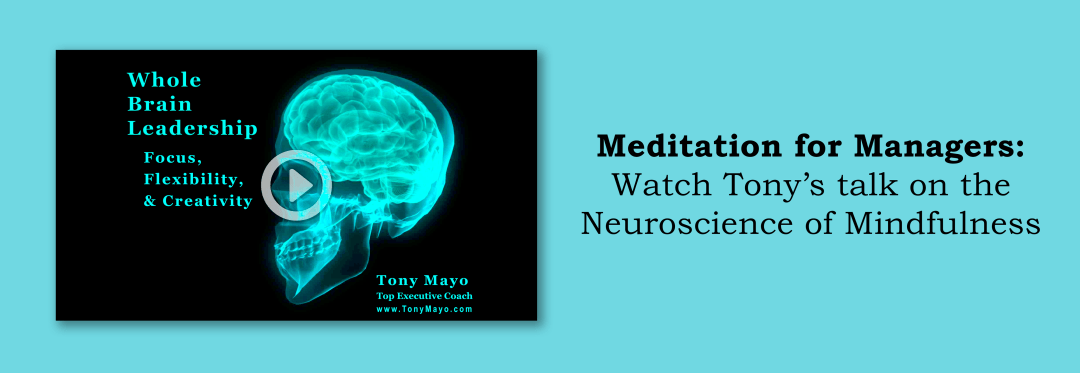
Great coaching from a sign in a casino, “You must be present to win.” A post on meditation for executives is here.
An executive’s job is to make a good enough decision with not enough information. –Tony Mayo
Why your company must grow–or die. See the chart here.
Prior tweets are here, at Twitter Logs.
___
© 2009 Tony Mayo
by Tony Mayo | For Business Owners, For Executive Coaches
…chronically stressed rats lost their elastic rat cunning and instead fell back on familiar routines and rote responses, like compulsively pressing a bar for food pellets they had no intention of eating. … regions of the brain associated with executive decision-making and goal-directed behaviors had shriveled, while, conversely, brain sectors linked to habit formation had bloomed.
 Behaviors become habitual faster in stressed animals than in the controls, and worse, the stressed animals can’t shift back to goal-directed behaviors when that would be the better approach.
I call this a vicious circle.
—Nuno Sousa, MD PhD
Life and Health Sciences
Research Institute
But with only four weeks’ vacation in a supportive setting free of bullies and Tasers, the formerly stressed rats looked just like the controls, able to innovate, discriminate and lay off the bar. Atrophied synaptic connections in the decisive regions of the prefrontal cortex resprouted, while the overgrown dendritic vines of the habit-prone sensorimotor striatum retreated.
–Brain Is a Co-Conspirator
in a Vicious Stress Loop
NYTimes.com

Recent Comments